Help! I have drop foot!
Drop foot can have several different causes. To determine the most appropriate treatment, it is important to identify the underlying cause first. This is usually done through a combination of a physical and neurological examination. In some cases, additional tests, such as a nerve conduction study or an MRI scan, may be required.
If you have drop foot, you will quickly notice how much it affects your daily life. Walking requires more effort, you are more likely to trip, and your gait changes noticeably. It is therefore understandable that you want to find a solution as soon as possible. In this article, you will learn more about the devices that can help manage drop foot, ranging from lightweight braces to advanced ankle-foot orthoses.
What is drop foot?
Following surgery, nerve damage or trauma, the muscles responsible for lifting the foot may become weakened or stop functioning altogether. This may be temporary, but permanent damage is also possible. As a result, you may no longer be able to lift your foot properly or at all.
Drop foot can have a major impact on your daily activities. The condition affects your walking pattern, makes walking more tiring and increases the risk of tripping over small obstacles.
Drop foot is a condition in which the front part of the foot drops downward while walking. This is caused by weakness or paralysis of the muscles at the front of the lower leg. As a result, your foot may catch on steps, curbs or thresholds.
To determine whether someone has drop foot and identify the underlying cause, the following examinations may be performed:
- Physical and neurological examination
- Electromyography (EMG)
- Nerve conduction study (NCS)
- Imaging, such as an MRI scan
Types of examinations and their purpose
| Examination | What it measures | Why it is relevant for drop foot |
|---|---|---|
| Physical and neurological examination | Muscle strength, reflexes and nerve function | Helps determine where the impairment is located |
| EMG | Muscle activity and signs of denervation | Helps determine the location and nature of the nerve damage |
| NCS | Nerve conduction velocity and signal amplitude | Helps distinguish between myelin damage and nerve fibre damage |
| MRI or MR neurography | Anatomy of the spine and peripheral nerves | Can reveal nerve compression or nerve injury |
| Clinical tests | Responses to pressure and movement, such as Tinel’s and Lasègue’s tests | May indicate a problem affecting a specific nerve pathway |
Causes of drop foot
Drop foot is usually caused by a problem affecting the nerves that control the foot-lifting muscles, particularly the peroneal nerve. This nerve may become compressed after trauma, prolonged squatting or knee surgery.
Conditions such as a lumbar herniated disc, multiple sclerosis or polyneuropathy may also cause drop foot. In other cases, drop foot develops after surgery, due to a muscle disorder or as the result of a congenital neurological condition. The underlying cause largely determines which treatment or assistive device is most suitable.
Assistive devices and orthoses for drop foot
Several assistive devices are available for people with drop foot. These devices help prevent the foot from dragging during the swing phase of walking or dropping uncontrollably when the heel strikes the ground.
Drop foot braces are mainly intended for people with weakened foot-lifting muscles and mild drop foot. Ankle-foot orthoses (AFOs) are more commonly used for severe drop foot, more extensive neurological injuries or in combination with spasticity.
In our webshop, you will find the following drop foot braces, among others:
- Orliman Boxia Drop Foot Brace
- Orliman Boxia Plus Drop Foot Brace
- Össur Foot-Up
- Össur Rebound Foot-Up
- Reh4Mat Drop Foot Brace
- Thuasne SpryStep Flex EVO
- TurboMed Orthotics XTERN-SUMMIT AFO
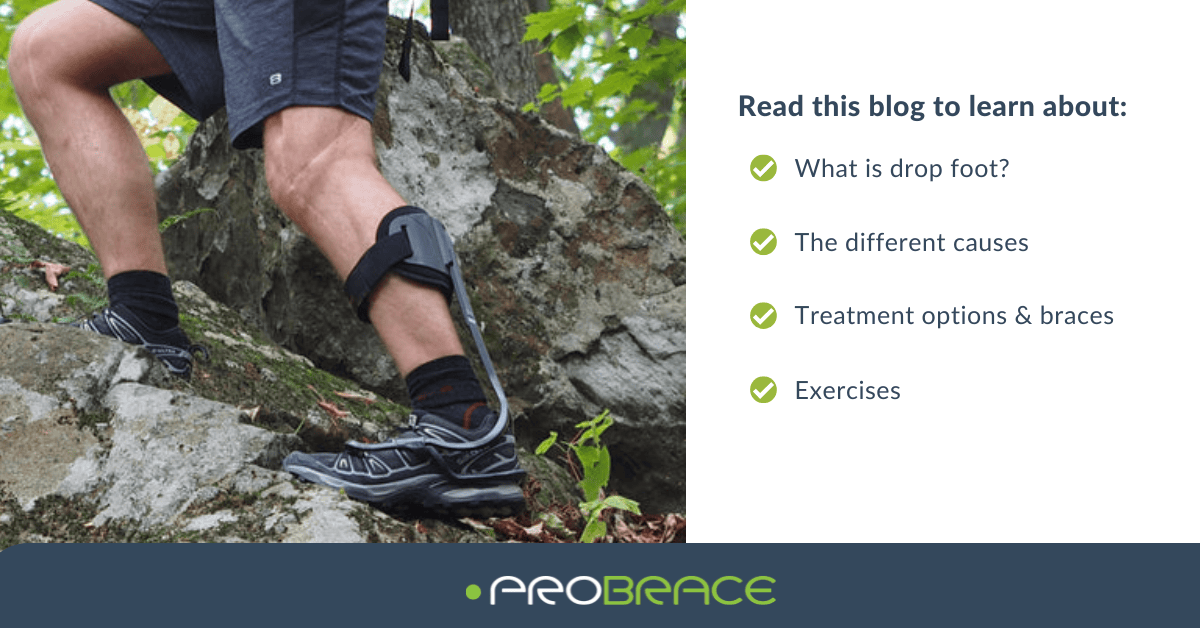
A simple yet effective example of a drop foot brace is the Össur Foot-Up. This brace is suitable for mild drop foot and can easily be attached between the shoe and the ankle.
The Thuasne SpryStep Flex EVO is worn inside the shoe, while the TurboMed Orthotics XTERN-SUMMIT AFO is attached to the outside of the shoe.
The drop foot braces from Orliman, Össur and Reh4Mat generally do not need to be fitted by a certified orthotist. You can determine the correct size yourself using the sizing chart on each product page.
Drop foot orthoses that are worn inside or on the shoe cannot always be ordered online without adjustment. Therefore, we prefer to supply the Thuasne SpryStep Flex EVO and the TurboMed Orthotics XTERN-SUMMIT AFO during a personal consultation.
The Thuasne SpryStep Flex EVO does not always fit every shoe immediately and may need to be trimmed. The TurboMed Orthotics XTERN-SUMMIT AFO must also be assembled and adjusted by one of our certified orthotists. This can be done during a consultation at our clinic in Amersfoort.

Exercises for drop foot
The treatment of drop foot depends on the underlying cause. When a nerve is compressed, reducing the pressure on that nerve can be an important part of recovery. Adjusting your posture and daily habits may also help.
In addition, there are exercises that can help improve control of your ankle and foot. For severe muscle weakness or complete paralysis, a combination of physiotherapy, targeted exercises and a drop foot brace often provides the best support.
Stretching the Achilles tendon
Step 1: Stand upright with both feet flat on the floor. If necessary, support yourself with your hands on a chair, table or wall.
Step 2: Slowly bend both knees while keeping your heels firmly on the floor. Stop as soon as you feel a stretch in your Achilles tendons. Hold this position for five seconds, then return to the starting position. Repeat the exercise ten times.
Calf stretch
Step 1: Stand facing a wall and place your hands against it. Step one leg as far back as possible while keeping your heel on the floor.
Step 2: Hold this position for five seconds, then return to the starting position. Repeat the exercise ten times.
Strengthening the foot-lifting muscles while seated
Step 1: Sit on a chair and place the affected leg over your other knee so that your ankle hangs freely and your lower leg is horizontal.
Step 2: Lift your big toe and forefoot as high as possible towards the ceiling. If you would like to add resistance, use an exercise band or attach a small weight to your forefoot. Repeat the movement as many times as feels comfortable.
Moving the foot inward against resistance
Step 1: Sit on a chair with both feet flat on the floor. Place an exercise band around the affected foot and secure the other end to a fixed object, such as a table leg.
Step 2: Move your foot inward and slightly upward against the resistance of the band while keeping your heel on the floor. Repeat this movement several times.
Moving the foot outward against resistance
Step 1: Sit on a chair with both feet flat on the floor. Place an exercise band around both forefeet.
Step 2: Move the affected foot outward and upward against the resistance of the band. Keep your heel on the floor throughout the movement. Repeat this exercise several times.
Frequently asked questions about drop foot
Can you drive with drop foot?
Whether you can safely drive with drop foot varies from person to person and depends on several factors. ProBrace cannot determine whether you are medically or legally fit to drive.
Always discuss this with your treating physician. It may also be wise to contact your insurance company. If your doctor confirms that you are allowed to drive, you should notify your insurer that you have drop foot. This ensures that your condition is documented in the event of an accident or other incident.
Can you run with drop foot?
Whether running is possible with drop foot also varies from person to person. We therefore recommend seeking advice from a physiotherapist, general practitioner, neurologist or medical specialist.
You are also welcome to visit the ProBrace consultation clinic. Consultations are without obligation but are available by appointment only. Please contact our customer service to schedule an appointment.

Directly to:
- Help! I have drop foot!
- What is drop foot?
- Types of examinations and their purpose
- Causes of drop foot
- Assistive devices and orthoses for drop foot
- Exercises for drop foot
- Stretching the Achilles tendon
- Calf stretch
- Strengthening the foot-lifting muscles while seated
- Moving the foot inward against resistance
- Moving the foot outward against resistance
- Frequently asked questions about drop foot
- Can you drive with drop foot?
- Can you run with drop foot?